The Short Answer
If you want the lowest upfront cost and don't mind annual maintenance, choose pressure-treated wood. If you want to install once and forget about it for 25+ years, choose composite. Most of our Peabody, MA & North Shore clients now choose composite, but wood still has its place — especially on traditional homes and budget-conscious builds.
Upfront Cost: Wood Wins
Pressure-treated lumber typically runs $15–$25 per square foot installed. Composite decking, depending on brand and color, runs $30–$60 per square foot. On a 400 sq ft deck, that's the difference between $8,000 and $20,000+.
But "upfront" is the key word. Add 25 years of staining, sealing, and board replacement to a wood deck and the math gets a lot closer.
Maintenance: Composite Wins by a Mile
A pressure-treated deck needs:
- Power washing every 1–2 years
- Staining or sealing every 2–3 years
- Board replacement as splits, cups, and rot show up (typically year 8–12 in our climate)
A composite deck needs:
- An occasional rinse with soapy water
- That's it.
"I tell every client the same thing: the cheapest deck is the one you don't have to think about for 20 years. That's almost always composite."
Julio Wolf, Wolf Carpenters
Lifespan: Composite Wins
A well-built pressure-treated deck in Peabody, MA & North Shore lasts 15–20 years with diligent maintenance. A composite deck from a top brand (Trex, TimberTech, Fiberon) carries a 25–50 year warranty against rot, fade, and staining. We've installed composite decks in 2010 that still look brand-new.
Appearance: Personal Preference
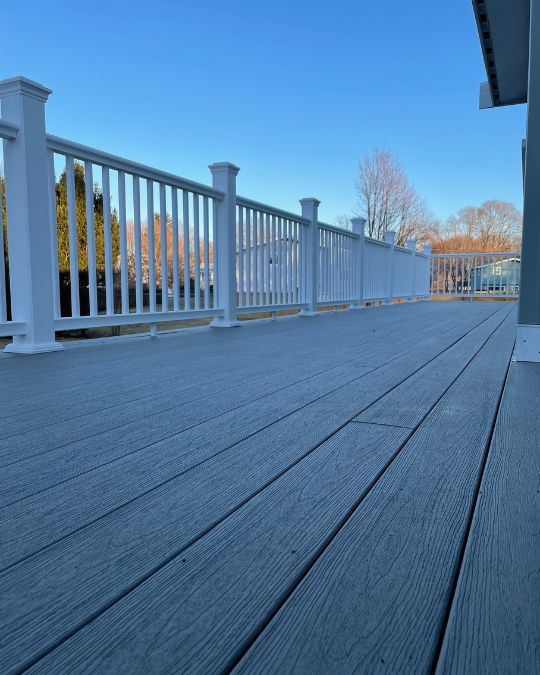
Modern composite has come a long way. The early generation (chalky, plastic-looking) is gone. Today's top-tier composite has multi-tonal grain patterns that pass for hardwood from a few feet away. Wood, of course, has the warmth and irregularity that nothing synthetic can fully match.
If you want your deck to feel like an extension of a colonial or craftsman home, wood may win on character. If you want a clean, modern look that stays clean and modern, composite is hard to beat.
Heat & Comfort
One honest knock on composite: dark colors get hot in summer sun. If your deck has full southern exposure, choose lighter shades or capped composite designed to stay cooler. Wood stays slightly cooler underfoot but also fades and grays faster in direct sun.
Resale Value
The latest Cost vs. Value Report shows wood decks recouping about 65–70% at resale, composite about 60–65%. Wood edges out slightly on ROI, but composite is what most buyers in Peabody, MA & North Shore now expect on a higher-end home. We're seeing composite become a selling feature in towns like Beverly, Marblehead, and Salem.
What We Recommend
For a forever home where you want zero hassle: composite, every time.
For a rental, flip, or budget-tight starter home: pressure-treated wood, properly sealed, looks great and lasts plenty.
For a custom statement deck where you want exotic appearance: ipe or mahogany, a third path we cover in a separate post.
Whatever you choose, the build quality matters more than the material. A poorly-built composite deck is worse than a well-built wood deck. Joist spacing, fastener choice, flashing details, drainage — that's where decks succeed or fail.
Want our team to walk your yard and quote both options side-by-side? Wolf Carpenters has built hundreds of decks across Peabody, Salem, Danvers, Beverly, and Gloucester. No-obligation estimates, always.
Ready to Build Your Deck?
Get your free consultation with Wolf Carpenters. We'll quote composite and wood side-by-side so you can decide with real numbers. Serving Peabody, Salem, Danvers, Beverly, and all of Peabody, MA & North Shore.
Get a Free Quote